
Quick Answer
Pond muck is decomposing organic material that accumulates at the bottom of ponds over time. It forms from leaves, algae, fish waste, and other debris, especially when oxygen levels are too low for complete breakdown. As muck builds up, it can contribute to odor, reduced dissolved oxygen, nutrient release, and gradual loss of pond depth.
If you’re unsure how large your pond is, you can estimate the size using our Pond & Lake Size Calculator to determine the proper aeration or bacteria treatment.
Where Does Pond Muck Come From?
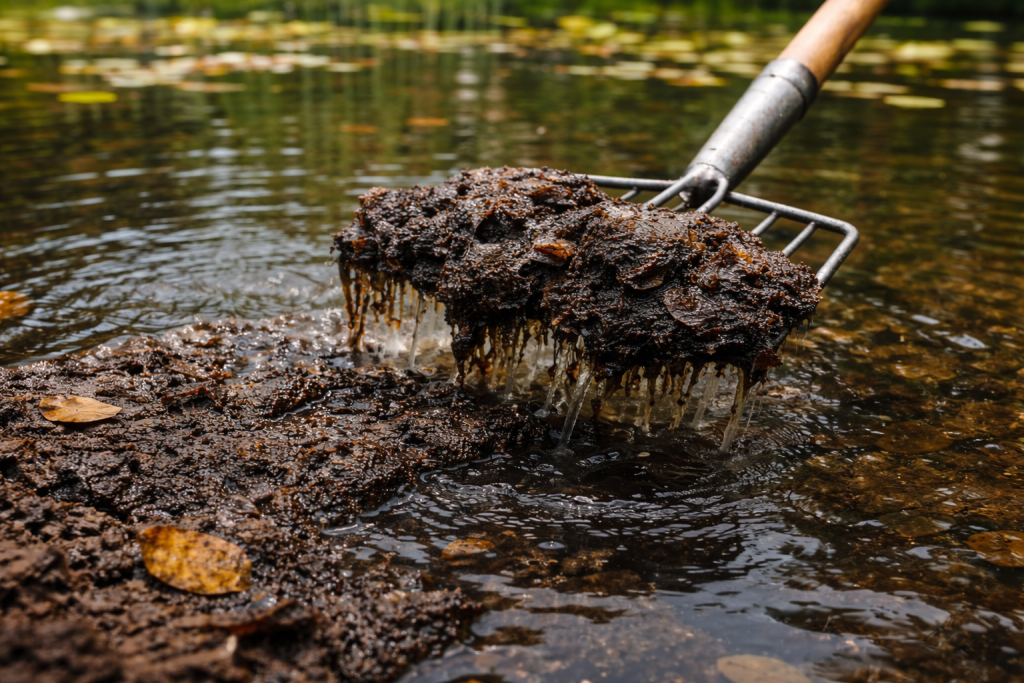
Pond muck is the layer of soft, dark sediment that accumulates on the bottom of ponds over time.
It is primarily made up of decomposing organic material mixed with inorganic sediment. Common contributors include:
- Fallen leaves
- Grass clippings and yard debris
- Fish waste
- Uneaten fish food
- Decaying aquatic plants
- Organic runoff from surrounding land
As these materials settle to the bottom, they begin to decompose. Over time, this partially decomposed material forms a soft sludge layer commonly referred to as “muck.”
How Pond Muck Accumulates
Organic matter naturally breaks down through biological decomposition. This process requires oxygen.
In ponds, oxygen is typically most available near the surface where water interacts with the atmosphere and wind-driven mixing occurs. In deeper or stratified ponds, oxygen levels can decline in lower layers.
During warm months, many ponds experience thermal stratification:
- The upper layer (epilimnion) remains warmer and well-oxygenated.
- A middle transition zone (thermocline) forms where temperature changes rapidly with depth.
- The lower layer (hypolimnion) becomes cooler and may receive limited oxygen replenishment.
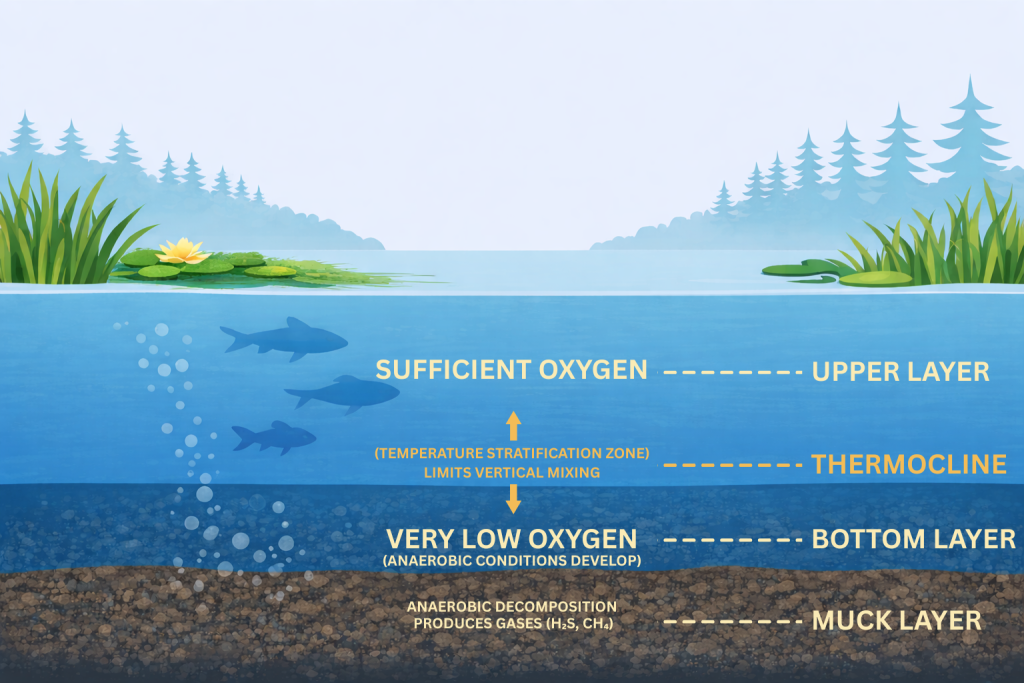
In stratified ponds, limited vertical mixing can allow oxygen levels to decline in deeper layers. When oxygen becomes very low near the bottom, decomposition slows and organic material accumulates as muck.
Because the thermocline limits vertical mixing, oxygen-rich surface water does not readily circulate into deeper layers.
If oxygen becomes very low near the bottom:
- Decomposition slows.
- Anaerobic (low-oxygen) conditions develop.
- Organic material accumulates faster than it fully breaks down.
Under anaerobic conditions, certain gases such as hydrogen sulfide (H₂S) and methane (CH₄) can be produced as byproducts of decomposition.
Over time, this process leads to thickening sediment and sludge buildup.
How Pond Muck Affects Your Pond
Excessive muck can influence pond conditions in several ways.
1. Dissolved Oxygen Levels
As organic material continues decomposing, it consumes oxygen. In ponds with significant organic loading, this can contribute to reduced dissolved oxygen in deeper areas.
Low dissolved oxygen can stress fish and other aquatic organisms, especially during warm summer months.
2. Odor Formation
Hydrogen sulfide (H₂S), produced under anaerobic conditions, is responsible for the characteristic “rotten egg” odor sometimes noticed when bottom sediments are disturbed.
3. Nutrient Availability
Decomposing organic matter contains nutrients such as nitrogen and phosphorus. As sediment accumulates, these nutrients can become available in the water column under certain conditions, potentially contributing to algae growth.
Beneficial bacteria products are not algae treatments, but reducing organic sludge can help lower long-term nutrient accumulation.
4. Gradual Loss of Depth
Over time, sediment buildup can make ponds shallower. Shallower ponds warm more quickly and may be more prone to plant and algae growth.
How to Manage and Reduce Pond Muck
There is no single instant solution for pond muck. Management typically involves a combination of strategies.
1. Reduce Organic Inputs
Limiting the amount of organic material entering the pond can slow future accumulation.
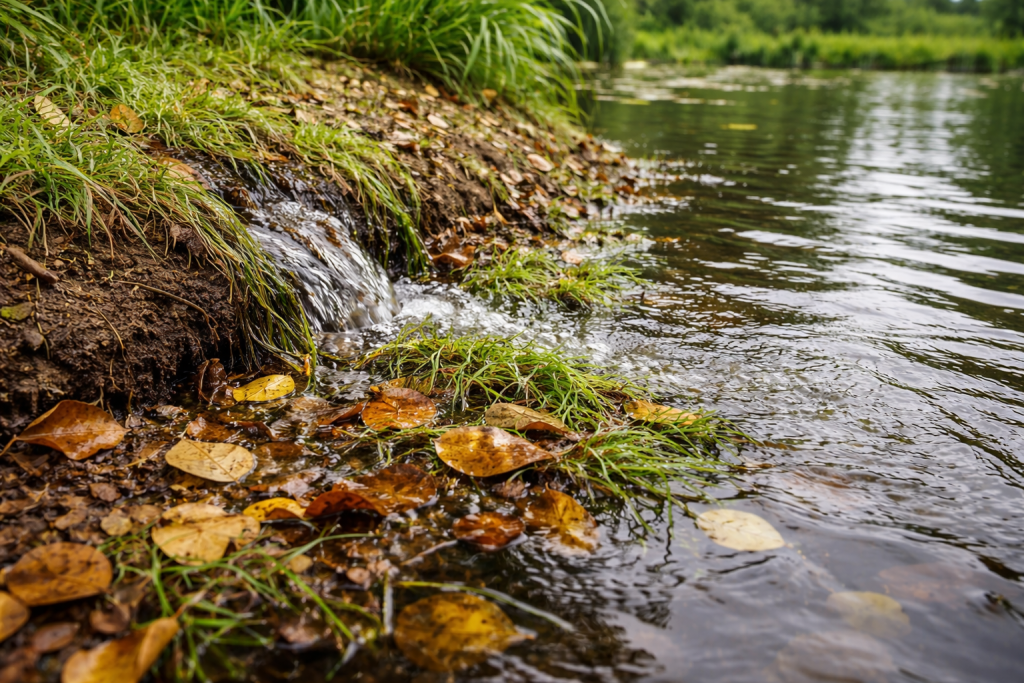
Examples include:
- Keeping grass clippings away from shorelines
- Managing leaf fall where practical
- Reducing excess fish feeding
- Controlling runoff when possible
2. Improve Oxygen Levels
Increasing dissolved oxygen supports natural decomposition processes.
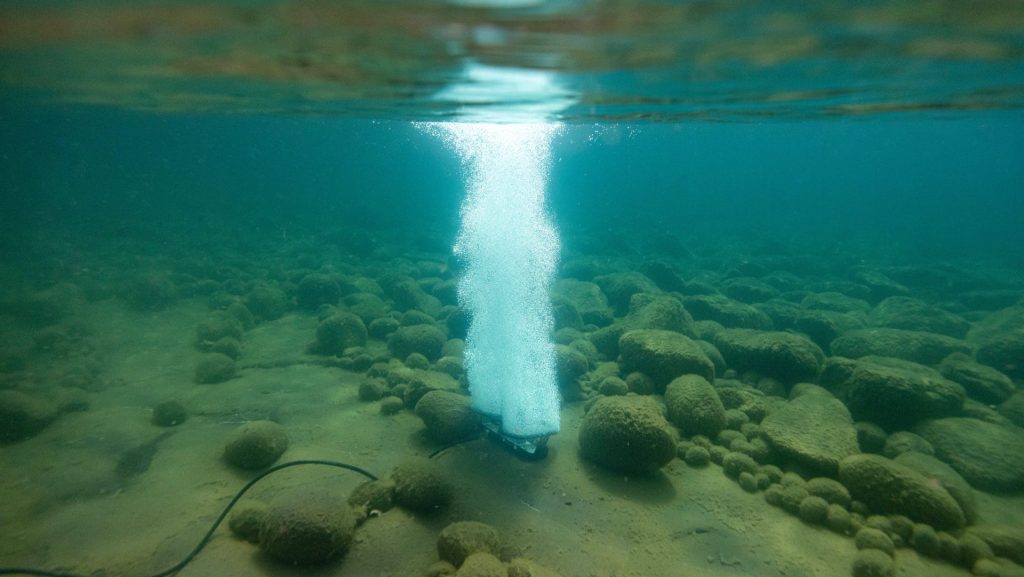
Options include:
Aeration can improve circulation and reduce the likelihood of persistent low-oxygen bottom conditions, particularly in deeper ponds. Learn more about the differences between pond fountains, surface aerators, and diffused air systems in our guide to choosing the right aeration system.
3. Use Beneficial Bacteria (When Conditions Are Suitable)
Beneficial bacteria products, such as Kasco Pond Probiotics, contain heterotrophic bacteria strains designed to digest organic material.
According to manufacturer guidance:
- They perform best in water temperatures above approximately 55°F (13°C).
- Adequate dissolved oxygen improves performance.
- They are designed for freshwater use.
Beneficial bacteria accelerate natural biological processes but do not instantly remove sludge. Results depend on temperature, oxygen levels, organic load, and pond size.
For accurate dosing, pond volume should be estimated in gallons or acre-feet before application. Our Pond Probiotics Calculator can help estimate the amount of beneficial bacteria needed based on pond size.
Important Clarification
Severe sediment buildup may require mechanical removal (such as dredging) if accumulation has occurred over many years. Biological management strategies are most effective as part of ongoing maintenance rather than as a single corrective measure for extreme buildup.
Final Thoughts
Pond muck is a natural result of organic material settling and decomposing in aquatic systems. Accumulation occurs when decomposition slows due to limited oxygen availability, particularly in deeper or stratified ponds.
Understanding:
- What muck is
- How stratification affects oxygen distribution
- How anaerobic conditions develop
allows pond owners to make informed decisions about aeration and biological management.
Proper oxygenation and responsible organic management are the foundation of long-term pond health.
Frequently Asked Questions
Does pond muck go away on its own?
Pond muck naturally decomposes over time, but the rate of breakdown depends on oxygen levels, temperature, and organic loading. In low-oxygen conditions, decomposition slows significantly, allowing sludge to accumulate faster than it breaks down.
Is pond muck harmful to fish?
Muck itself is not inherently harmful. However, excessive organic buildup can contribute to low dissolved oxygen in deeper areas of the pond. Prolonged low oxygen levels can stress fish, especially during warm summer months when oxygen demand is higher.
Why does pond muck smell like rotten eggs?
The “rotten egg” odor is typically caused by hydrogen sulfide (H₂S), a gas produced during anaerobic (low-oxygen) decomposition of organic material in bottom sediments.
Does beneficial bacteria instantly remove pond muck?
No. Beneficial bacteria accelerate natural biological processes, but they do not instantly remove accumulated sludge. Results depend on temperature, oxygen levels, pond size, and the amount of organic material present.
Will aeration remove pond muck?
Aeration does not physically remove sediment. However, increasing dissolved oxygen supports natural decomposition and can reduce the likelihood of persistent low-oxygen bottom conditions, particularly in deeper or stratified ponds.
Still have questions?
Contact our pond fountain specialists →

The Fountain Guys
Pond fountain and aeration specialists since 1999.
Our Knowledge Center shares real-world installation,
maintenance, and troubleshooting advice.