
Quick Answer
- Double mooring rope: Best for most residential ponds.
- Bottom anchoring: Best for permanent installations, fishing ponds, or ponds used for boating.
- Single mooring rope: Acceptable for smaller fountains in calm conditions.
Properly anchoring a floating pond fountain — such as an RHP Series Fountain — keeps it centered, protects the power cord, reduces excessive swing, and makes long-term maintenance easier. The best anchoring method depends on how your pond is used — decorative display, fishing, boating, or seasonal removal.
There are three primary anchoring methods:
- Double Mooring Rope (Shore Stake Method): Uses two shoreline attachment points for balanced tension and easy centering.
- Bottom Anchoring: Uses concrete blocks or boat anchors placed beneath the surface for a clean shoreline appearance.
- Single Mooring Rope (Small Fountains Only): Uses one shoreline attachment point and is suitable for smaller fountains in calm conditions.
Each method has advantages and trade-offs, which we’ll explain below.
Before You Start
Before installing your fountain, verify the following:
- Minimum water depth at the intended install location
- GFCI-protected outlet
- Power cord is undamaged
- Mooring rope length is sufficient
- Prevailing wind direction
If you’re unsure about proper fountain sizing for your pond, see our complete pond fountain sizing guide.
Wind direction plays a larger role than most pond owners expect. Taller spray patterns catch more wind and may require slightly tighter mooring rope adjustments.
Method 1: Double Mooring Rope (Shore Stake Installation)
This is the most common and user-friendly anchoring method. It provides balanced tension, easy seasonal removal, and simple centering adjustments. It is ideal for residential decorative ponds and installations where maintenance access is important.
Fountains designed with dual mooring rope attachment points allow for balanced tension and easier centering. For example, our 26″ poly float includes two mounting points positioned opposite each other, which helps distribute load evenly and improves stability in changing wind conditions.
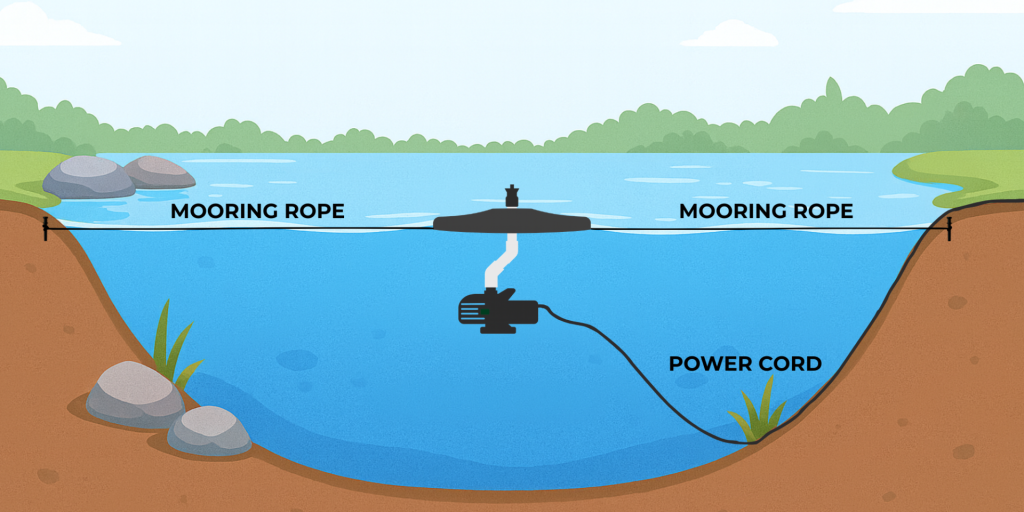
Step-by-Step Installation
- Secure the First Stake: Drive the first shoreline stake firmly into the ground at or just below the waterline. Attach the first mooring rope securely.
- Position the Fountain: Place the fountain in the pond with the second mooring rope already attached. Ensure the power cord runs naturally toward shore without tension.
- Walk the Second Mooring Rope Across: Walk the second mooring rope around the pond to the opposite shoreline.
- Drive the Second Stake: Drive the second stake directly across from the first anchor point and secure the rope.
- Center the Fountain: Pull evenly from both mooring ropes and adjust until the fountain sits centered. Ropes should be snug, not overtightened.
Double Mooring Rope – Advantages
- Balanced tension
- Easy seasonal removal
- Simple maintenance access
- No boat required
Double Mooring Rope – Considerations
- Shoreline stakes may be visible
- Mooring ropes may create minor snag points if not planned carefully
Installation Tip
This method is significantly easier with two people. One person holds light tension on the first mooring rope while the second walks and secures the opposite rope. Once both stakes are set, each person can pull evenly to fine-tune centering.
Method 2: Bottom Anchoring (Concrete Blocks or Boat Anchors)
This method is ideal for larger ponds, fishing ponds, and recreational ponds where shoreline stakes are undesirable. It provides a cleaner appearance and reduces surface-level snag risk.
Concrete blocks are commonly used because they provide predictable holding power and work well in most pond bottoms.
Alternative Anchor Option: Boat Anchors
In place of concrete blocks, some pond owners choose to use boat anchors. This can be effective in soft-bottom ponds where the anchor can properly set and dig into the sediment.
However, holding strength depends heavily on bottom composition and anchor style. In rocky or compacted bottoms, traditional boat anchors may not set properly. In many residential ponds, solid concrete blocks provide more consistent and predictable holding power.
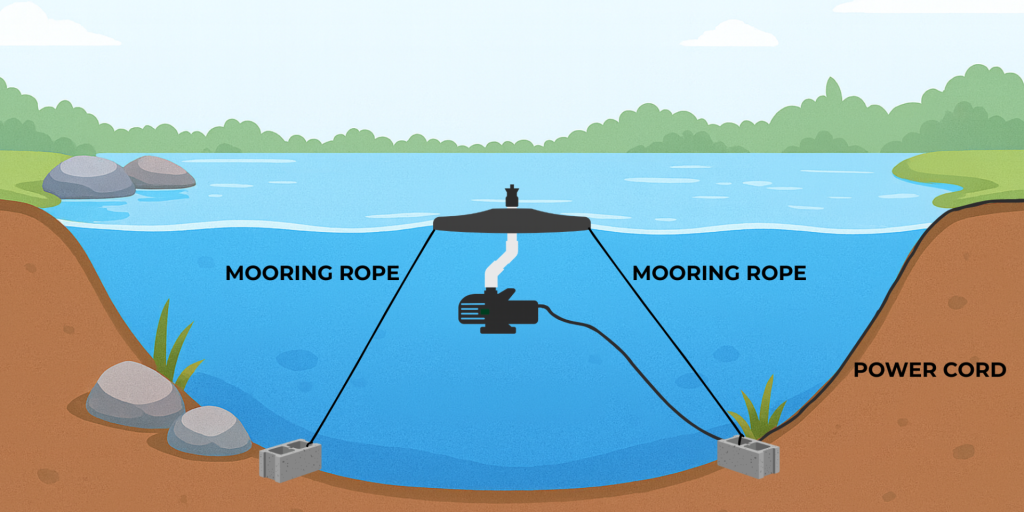
Step-by-Step Installation
- Position the Fountain: Using a boat, move the fountain to its desired location.
- Attach Equal-Length Mooring Ropes: Secure two equal-length mooring ropes to opposite sides of the float.
- Lower the First Anchor: Boat to the first anchor position and lower the concrete block or boat anchor straight down.
- Cross Directly Over the Fountain: Drive straight across to the opposite side of the fountain.
- Lower the Second Anchor: Lower the second block or anchor straight down. The fountain should sit evenly between both anchor points.
The anchors should be dropped 5' to 10' away from the float as show above. This prevents the pump from potentially twisting up on the anchor lines.
Bottom Anchoring – Advantages
- Clean shoreline appearance
- No visible stakes
- Reduced snag risk
- Very stable in open or windy ponds
Bottom Anchoring – Considerations
- Requires a boat
- Harder to reposition
- Makes maintenance more involved
- Seasonal removal can be difficult
Method 3: Single Mooring Rope (Small Fountains Only)
This method may be used for smaller fountains in protected ponds. It is best suited for 1/3 HP units and some 1/2 HP installations in calm conditions. The double mooring rope method is still recommended whenever possible.
In smaller units, the power cord will naturally sink and rest along the pond bottom, which can provide minor stabilizing resistance in calm conditions. However, the mooring rope should always be used for proper positioning.
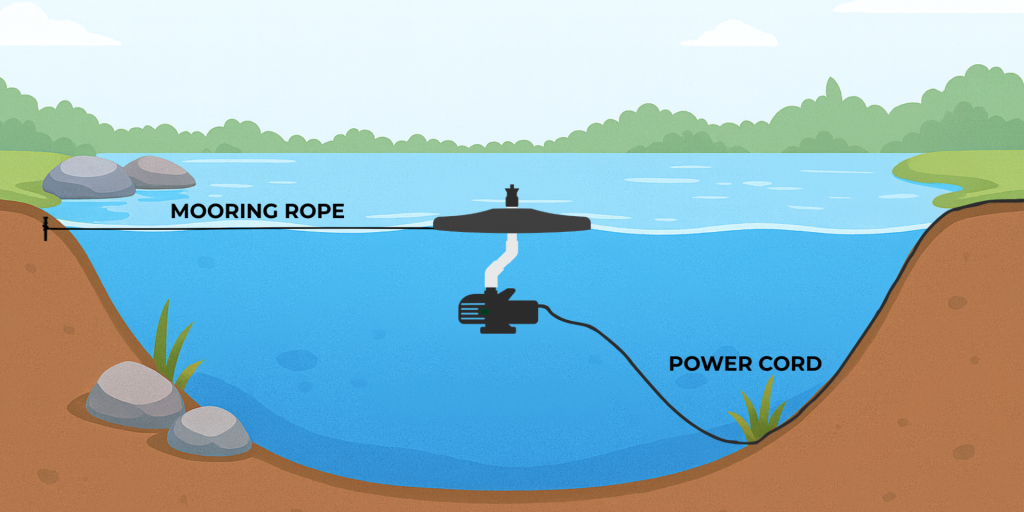
Step-by-Step Installation
- Secure the Power Cord First: Wrap the power cord around a solid post or have another person hold it securely at shore.
- Place the Fountain: Gently position the fountain in the pond with slight natural slack in the cord.
- Walk and Secure the Mooring Rope: Walk the mooring rope around the pond and drive the shoreline stake.
- Adjust Carefully: Remove slack from the mooring rope but do not overtension.
- Tie Up Unused Cord on Shore: Coil and secure any extra power cord neatly on shore.
Fishing and Boating Considerations
Shoreline mooring ropes do not prevent fishing, but you must know where they are positioned. Avoid casting directly across them and keep them tight and predictable.
Safety Considerations
Floating pond fountains are electrical devices and should be treated accordingly. No one should enter the pond while the fountain is operating.
Although properly installed fountains are designed for safe operation, swimming or wading near an active unit increases risk due to electrical components, moving water, and submerged mooring ropes.
No one should enter the pond while the fountain is operating. Turn off and disconnect power before performing maintenance or making adjustments.
Frequently Asked Questions
Can I use the power cord as a mooring rope?
No. The power cord should not be used as a structural mooring rope. In smaller fountains, the cord will naturally sink and rest along the pond bottom, which may provide minor resistance in calm conditions. However, proper positioning should always be achieved using the mooring ropes, with the cord allowed to maintain slight slack.
Can I use my power cord as an anchor?
No. The power cord should never carry structural tension.
How long should my mooring ropes be?
Mooring ropes should be long enough to reach the shoreline or anchor point with slight slack. In deeper ponds, longer rope allows a better angle and improved holding strength. Avoid pulling ropes excessively tight.
Can I leave my fountain anchored year-round?
Yes, in many climates fountains can remain anchored year-round. However, in areas with freezing conditions, seasonal removal is often recommended to prevent ice damage and simplify maintenance.
What if my fountain keeps drifting off center?
Yes, in many climates fountains can remain anchored year-round. In freezing conditions, seasonal removal is often recommended to simplify maintenance and reduce surface ice concerns.
For RHP Series fountains, the pump is safe while fully submerged. The unit may remain in the pond turned off during winter as long as it stays below the ice line. If operated in freezing conditions, it should run continuously to maintain open water around the unit. Running intermittently in freezing weather can increase the risk of ice buildup and cause damage to the pump.
Still have questions?
Contact our pond fountain specialists →

The Fountain Guys
Pond fountain and aeration specialists since 1999.
Our Knowledge Center shares real-world installation,
maintenance, and troubleshooting advice.